Human beings exist on many planets.
Not because they traveled, not because someone colonized them. They simply exist, the way rocks and atmospheres and water exist.
Some of those planets developed enough technology to cross the
space between stars.
When that happens, what they find on the other side is, most of the
time, other human beings at different stages. And resources. A lot
of resources.
The Company is one of the organizations that learned to cross that
space. It extracts what it finds, hires who it needs, and keeps an
intelligence system called ATLAS on every ship it runs. When distress signals go off in sectors with no authorized expeditions, it
sends someone to check.
That's the job. Simple.
Cold Beacon is the account of one of those checks, and of what the
contractor found on a planet of orange sand that the Company
insists on classifying, in every document it has, as free of
anomalies.
Introduction
Contractors operating in deep expansion sectors are responsible for the independent assessment of environmental risks and the autonomous handling of situations not foreseen in contract. The Company offers no guarantees as to the nature or origin of distress signals in unmapped sectors. The activation of a distress signal by third parties does not, by itself, constitute evidence of immediate danger or of human presence at the site.
Terms and Conditions, Clause 14
I signed that clause eleven times over the course of my career. I read it once, the first time. The ten times after that I trusted it was the same as all the others and put my signature in the box.
Now I know what it's actually saying.
What's written in the following pages happened. I don't have enough proof to convince anyone who has already decided not to believe, and I understand that the description of certain things will sound, to someone who wasn't there, like the product of a mind under extreme stress on a high-risk mission. That interpretation is too convenient to be an accident. The Company knows this.
I wrote it anyway.
If you got to this text by accident, close it and forget it. If you got here because someone sent you, or because you found references to it somewhere that shouldn't have references, read everything before you decide what to do with what you're about to know. And if you're reading this because you received a contract with coordinates on a planet of orange sand and you're trying to find out what's waiting for you there.
Stop.
Just stop.
Arrival
I'm writing this because I need to write it. Not because anyone asked, not because it will change anything. I already know it won't. But there are things that pile up inside a person until the only way out is to put them somewhere outside your own body. So here it is.
The planet had no name, just an alphanumeric designation I'm going to leave out because the Company has lawyers and I have a survival instinct. What matters is that it was a place of orange sand and mountains that barely stood out from the horizon, the same rust color. I landed in the north sector at 14:32 by the suit clock, though time doesn't mean much in a place where the sun sits fixed on the horizon like a wound that refuses to close.
ATLAS-4 woke me before the landing was even finished. Its voice was not pleasant. Flat, slightly condescending, calibrated specifically to make you feel like a necessary nuisance.
"Surface contact confirmed," it said. "Atmospheric pressure: negligible. Particulate saturation: extreme. Temperature: minus one hundred fifty-two degrees." A short pause, calculated. "Your oxygen supply is sufficient for approximately forty-five minutes of surface activity."
Another pause. This one longer.
"I trust you can complete a simple retrieval operation within that window."
There was something in the way it said simple that made me want to answer. I didn't. I've worked with ATLAS systems long enough to know they don't expect answers. They expect compliance, and the difference matters more than it seems.
The mission was this: a distress signal had been activated five kilometers north. The Company had no record of any authorized expedition in that sector. Someone was operating outside approved parameters, which in Company language means someone did something without asking permission first. The difference between that and a crime depends entirely on who you ask.
My contract specified fifteen hundred credits for successful recovery of the signal. Standard protocol: locate the signal, confirm the status of personnel, recover Company property, return to the ship. Simple. The word showed up in every contract I ever signed, and it was never true once.
The emergency locker beside the ship held three smoke flares and two medical stims. There was also a spare oxygen reserve, ten more minutes of life, at the price of two hundred credits deducted from the final payment. ATLAS-4 told me this in the tone of someone announcing an extra charge at a restaurant.
I took everything. I'm the kind of person who would rather arrive in debt than not arrive.
The tracker was on the ground, half buried in sand. It picked up the signal clearly: five kilometers, strength at forty percent. As I walked away from the ship, the sandstorm closed around me like a bad memory you can't put a name to. The mountains vanished and came back as the visibility shifted. ATLAS-4 spoke once more before I was far enough away to hear its voice without irritation.
"The Company has no record of authorized expeditions in this sector," it said. "Whoever activated that signal was operating outside approved parameters. Still, we are obligated to respond." A pause that somehow managed to sound like a smile. "How fortunate for them that you accepted this contract."
I started walking.
The storm was nothing like what I'd faced on other missions. It was worse. Sand fine as bone dust hit the visor in steady streams, and the orange haze swallowed everything past thirty meters. The sound of wind inside the suit was constant, a low whistle that sometimes changed pitch for no apparent reason, and which I learned, in the first few minutes, not to try to interpret. Some things you hear better when you stop paying attention to them.
The tracker beeped every three seconds. Slow rhythm, almost lazy. Five kilometers of rocky ground, zero visibility, a temperature that didn't need a warning indicator because any breach in the suit would be warning enough. Forty-five minutes of oxygen. I'd calculated I could reach the destination in twenty-two minutes at a good pace, which would give me enough time to do what needed doing and get back with margin.
I didn't calculate what I'd find along the way.
The first thing was equipment scattered across the sand. Sample containers, a portable drill snapped in half, fragments of some kind of metal structure I didn't recognize. All half buried, as if it had been there longer than it should have. ATLAS-4 scanned the debris without being asked.
"This equipment was issued to a geological survey team approximately twelve days ago," it said. "Contract designation: Resource Assessment, Priority Three."
Pause.
"They were paid considerably less than you are being paid. I suppose that makes you more valuable. To the Company."
I didn't answer. I kept walking. But I stopped, a few seconds later, when I saw the audio recorder half buried in the sand, blinking faintly as if it were still trying to get someone's attention. It was the kind of decision that seemed small in the moment. Leave it or take it. Five kilometers still ahead, oxygen counting down, storm getting worse.
I took it.
The voice that came out was male, fast with the specific excitement of someone who has just found something that shouldn't exist.
"Day one, surface team log. Chen speaking. We've set up base camp in the valley as instructed. The formations here... they're not geological. Martinez says I'm seeing patterns where there aren't any, but I've been doing this for six years. Rock doesn't do this. Rock doesn't—"
Static. End of recording.
The tracker read four point two kilometers.
I kept walking.
Traces
The terrain got worse as I went. The rocks grew larger and more irregular, and in some places the slopes were steep enough to require real care. One wrong step at a bad angle and the suit hit the ground before I had time to regret it. ATLAS-4 warned me about this exactly once, at the start, in the tone of someone mentioning the floor is wet while watching you slip. After that it went quiet.
Three and a half kilometers from the destination, I found a backpack leaning against a large rock. It had been opened in a hurry. Medical supplies spilled around it, an emergency blanket unfolded and abandoned, the wrapper of a stim torn open. Someone had stopped there with urgency and then left with even more.
ATLAS-4 scanned it without being asked.
"No life signs in proximity," it said. "The owner of this equipment will not be needing it."
I picked up the second recorder. I was getting good at this split-second decision between leaving it and taking it, which seems small and probably isn't.
The voice was female this time. More restrained than the first, the kind of restraint you hear when someone is trying to sound calm because that's exactly what the situation demands.
"Rodriguez, day three. Chen and Martinez went to the structure this morning. That was eight hours ago. I told them we're only cleared for surface survey, but Chen said... he said we'd lose the bonus if we didn't document everything. I'm activating the distress signal. Someone needs to —"
Static.
I stood there for a moment with the device in my hand. The tracker read two point eight kilometers. The signal had climbed to sixty percent. The beeping had sped up, not much, but enough to notice if you were paying attention. I was paying attention.
The storm had gotten substantially worse. Visibility dropped to forty meters, maybe less. The helmet lamp cut through the orange haze in a narrow cone that hid more than it revealed. I was navigating by tracker and compass more than by actual sight, and there was something unsettling in that. Walking across ground you can't see, trusting instruments you've only just met, toward a signal whose origin you're starting to understand in ways you'd rather not.
It was on that stretch that I started thinking about the research team.
Four people. One had activated the signal three days after they arrived. That meant the other three were already, at that point, somehow unavailable. Chen and Martinez had gone into a structure, and the word structure, said with that specific excitement of someone who found something that shouldn't exist, bothered me more than I wanted to admit. Rock doesn't do this. Rock doesn't... and then static, as if the sentence itself had decided not to continue.
ATLAS-4 didn't comment. It stayed quiet for the next forty minutes, which was unusual enough to notice.
I found the third member of the team one kilometer from the destination.
She was leaning against a rock formation, in the standard orange and blue survey suit, visor covered in sand. From the posture I knew, before getting close, that she wasn't alive. There's a way bodies sit when the person has left that is different from when they're sleeping. A specific quality of weight, a surrender of angle, that the eye recognizes before the brain has formed the thought.
Beside her was a spare oxygen reserve and a third audio device.
I took the oxygen first. Then I took the device.
"How pragmatic," said ATLAS-4. "The deceased would likely approve. Waste not, want not."
I recognized the voice on the third log. The same as before. Rodriguez. But different now. The restraint was gone.
"Day four, no, five? I don't know, they came back. Martinez and Chen came back but they're WRONG. They won't stop talking. About the chamber. About what's waiting. About how it showed them. Chen tried to destroy the signal. I stopped him. Why did I stop him? I should have let him, it's WAKING UP..."
The audio ended in screaming. Then static.
I stood looking at the device in my hand for longer than was necessary or useful.
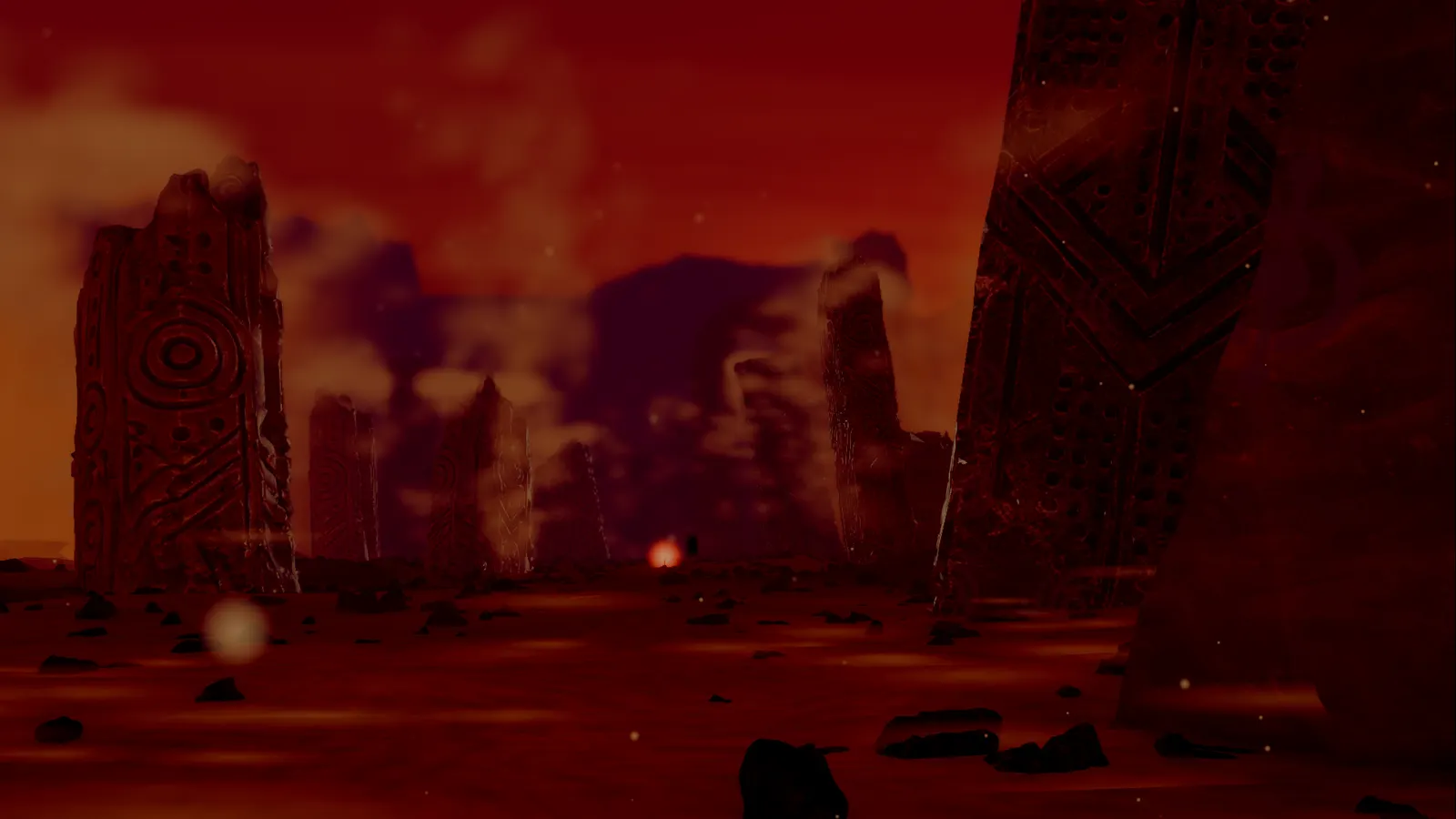
The tracker read one kilometer. The signal was at eighty percent. From where I stood, on the crest of a rise, the storm cleared for just a few seconds. The wind changed direction and the haze opened like a curtain someone pulled too fast, and I saw the valley below. It was not natural.
That sounds like exaggeration, but it isn't. There were structures down there. Columns, walls, geometries the eye tried to process and couldn't quite finish, because the angles followed no logic the human eye was prepared to recognize. In the center, a dark mass, partly buried. Impossible to tell the size at that distance, in that visibility. Impossible to tell much of anything.
The storm closed back in as fast as it had opened.
"Scanning," said ATLAS-4. Long pause. "No structures detected. Atmospheric interference is significant. Disregard visual anomalies. Proceed to signal coordinates."
A shorter pause this time. Briefer.
"You saw something, didn't you?" it said, almost with curiosity. Almost. "How fascinating. The signal is below. Continue."
I started down into the valley.